



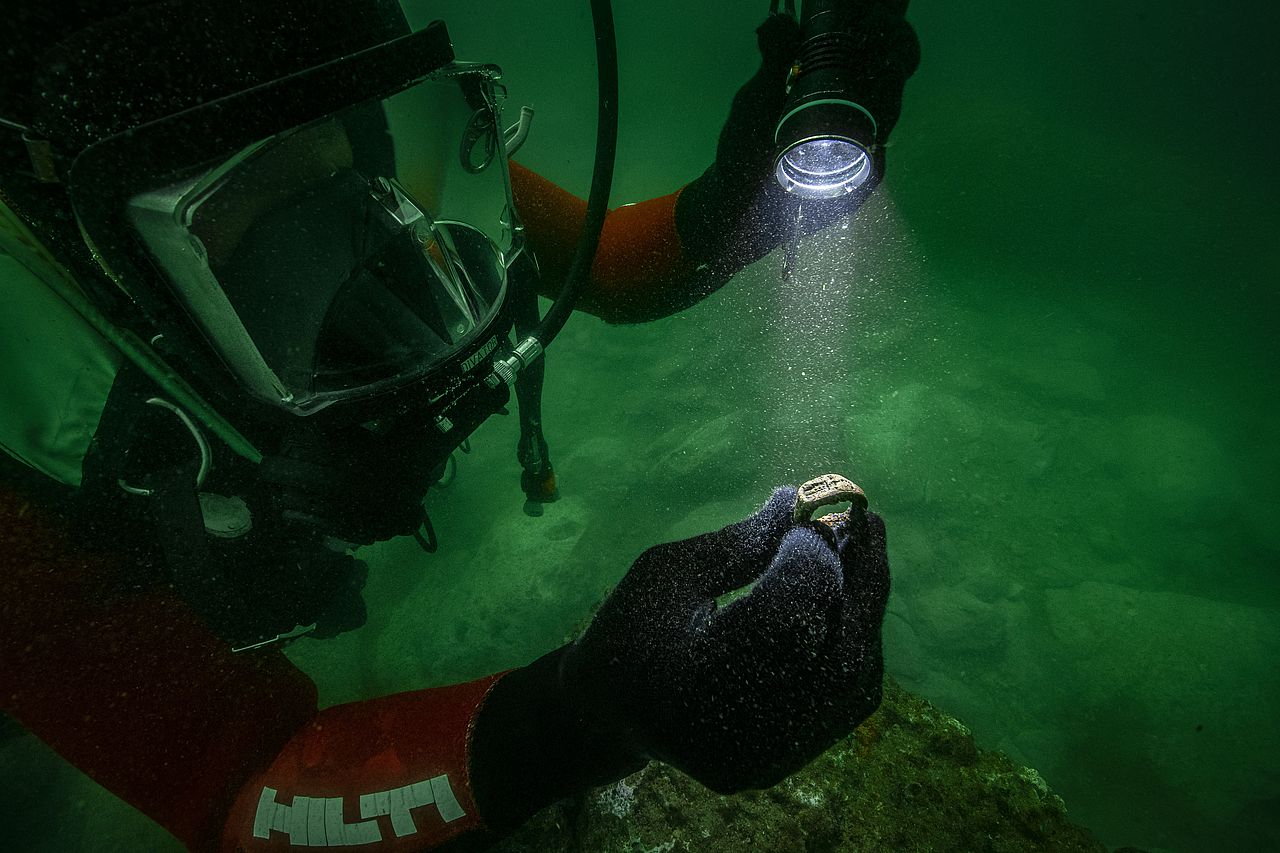
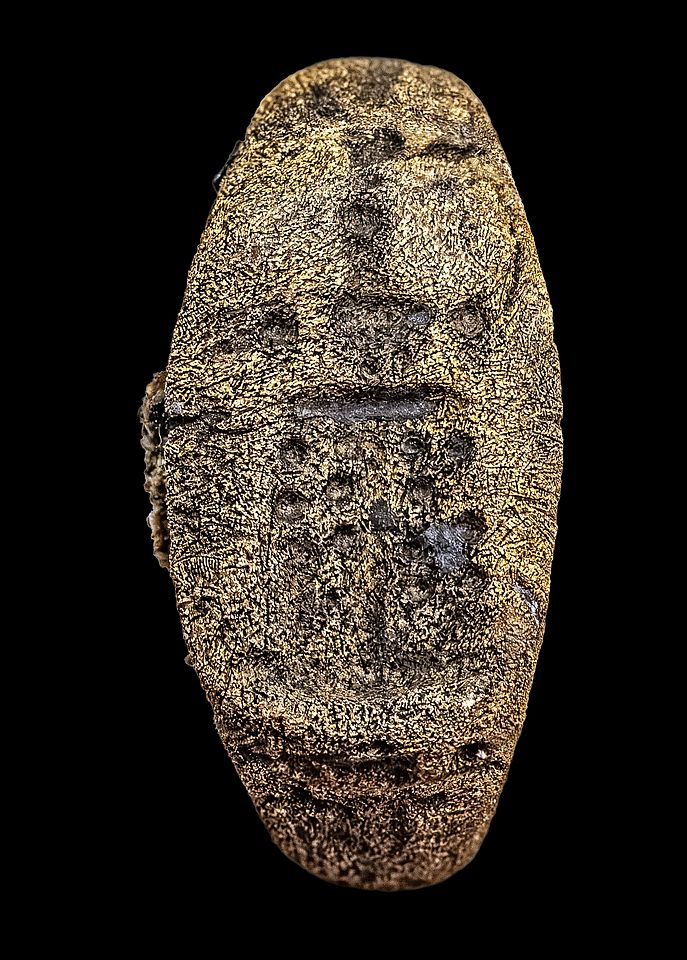
An exceptional discovery has been made at the site of the palace on the submerged Royal Island of Antirhodos, once part of the Royal Quarters of Alexandria’s Portus Magnus. During ongoing underwater excavations by the European Institute for Underwater Archaeology (IEASM), the team uncovered a bronze ring-signet depicting the Lighthouse of Alexandria — the first of its kind known to exist. The relief depiction of the lighthouse features iconography similar to that found on some 2nd century AD coins.
H.E. Sherif Fathy, Minister of Tourism and Antiquities in Egypt, together with his assistant, Dr Ahmed Rehema, visited the team onboard the research vessel in order to witness the underwater archaeological process of this year’s field mission and to see this latest discovery in person.
“The discovery of the ring-signet is even more important as it has been excavated in the legendary palace of the Island of Antirhodos, that once was a centre of power”, says Franck Goddio. It demonstrates that the palace — seen by Strabo during his visit to Egypt between 29 and 25 BC — had, at some point, some offices for administrative functions, including the administration of the famous lighthouse. The excavations on the Royal Island of Antirhodos are revealing architectural remains in an area extending to several thousand square meters.
The bronze object has been found, closely associated with intact ceramics of the second century AD. The ring-signet could, of course, be earlier, but it was obviously still in use at this period of the Roman occupation, when the royal palace of the Ptolemies had, most likely, been converted into an administrative building, housing the office of a lighthouse administrator.
On the side of the ring opposite the setting, the object features a small tab with round hole, allowing it to be suspended around the neck from a fine cord.
While there are numerous depictions of the lighthouse of Alexandria — on coins, semi-precious stone or glass intaglios, ceramic oil lamps, and even on a glass vessel found at Bagram (Afghanistan) which show differences depending on the period — this object offers what could be described as a perfectly official representation of the monument’s appearance at its time, displayed on a seal evidently used by an administrator of the famous structure.